Estimating Heterogeneous Treatment Effects of Driver Incentives in Ride-hailing Platforms
Article Sidebar
Main Article Content
Abstract
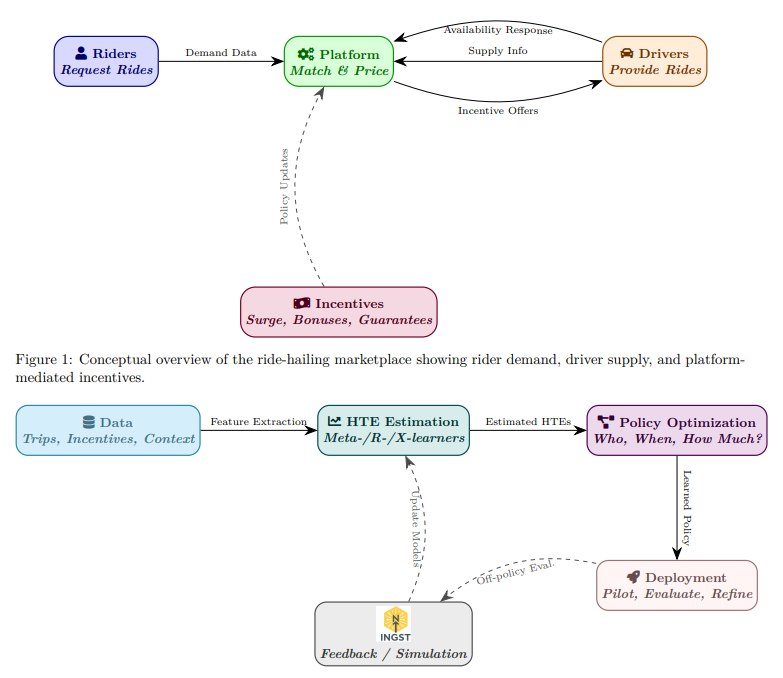
Ride-hailing and delivery platforms rely on a mix of monetary and non-monetary incentives to dynamically balance supply and demand in two-sided marketplaces. However, the average effect of any single incentive can mask substantial heterogeneity in behavioral responses across drivers and riders. This paper provides a methodological roadmap for estimating heterogeneous treatment effects of driver incentives in such an operational environment characterized by dynamic behavior, endogenous matching, and pervasive interference among agents. The roadmap formalizes causal estimands that capture direct effects on treated drivers, spillover effects on other drivers, and two-sided equilibrium effects including rider outcomes. Identification strategies are discussed for settings constrained by limited experimental control with an emphasis on approaches combining randomized variation-such as saturation and clustered randomization designs-with flexible, robust estimators, including meta-learners, causal forests, and doubly robust methods. Building on these heterogeneity estimates, a policy learning layer is proposed that translates HTEs into operationally constrained incentive assignments, subject to budgetary limits, fairness criteria, and service level guardrails. Validation procedures are outlined using held-out geographic regions and simulation-based stress testing to assess policy performance in a wide range of market conditions. The proposed framework is suited for capturing realistic heterogeneity across drivers-for example, full-time, part-time, students, retirees, newly onboarded, or experienced-and riders-for example, commuters, nighttime users, or occasional travelers-and for accounting for time-varying demand states and geographic frictions intrinsic to urban mobility markets.